

What Should You Plan Before Rebuilding a Home With Children?


Start with the stuff that actually breaks families
Most parents start with floor plans, façades, and Pinterest saves. Wrong order.
If you’re rebuilding with kids in the mix, the first job is pressure control. School drop-offs, sleep, meals, travel time, noise, money, temp accommodation, who’s picking up kids at 9 pm because someone’s got a fever. That’s the real project. The house comes second.
Ask the boring questions first. Where will you live? For how long? What's daily travel going to look like? Can the kids stay at the same school? Who handles mornings if one parent has to meet the site supervisor at 7 am? If you don’t lock that down early, the build starts running your family instead of the other way around.
Work out your living arrangement before you sign anything
Temporary housing can make or break the whole experience.
Staying with relatives sounds cheap until week three, when your toddler’s awake at 5:12 am and everyone’s pretending they’re “totally fine” with it. Renting nearby usually costs more, but it gives your family routine, privacy, and a chance of staying sane.
For most families, I tell them to choose accommodation based on school access first, work access second, and everything else after that. Kids handle disruption better when the weekday rhythm stays predictable. Same wake-up time. Same route. Same lunchbox drama.
If you’re comparing options, measure commute time properly. Not Google Maps at 11 am on a Sunday. Do the school run timing. Do peak hour. Do the daycare detour.
Budget for the real costs, not the fantasy version
Your builder’s price is not your full cost. Never was.
You need a rebuild budget, a relocation budget, and a chaos budget. If you only plan for the first one, you’ll get stung. Hard.
The usual misses are storage, rent overlap, extra fuel, takeaways when the week goes off the rails, replacement uniforms, moving costs, utility connections, and the random purchases that happen because your life is half in boxes. Then there’s the sneaky stuff. Lost work hours. Extra childcare. Trades delays that stretch temp housing longer than expected.
I like families to carry a contingency of at least 10 percent to 15 percent on top of known project costs. More if the site is tricky or the design is ambitious. People hate hearing that. They hate running out of money more.
Make decisions based on school terms, not builder optimism
Builders often talk in best-case timelines. Families don’t live in best-case conditions.
If you can line up demolition, moving, or handover with school holidays, do it. Even a partial overlap helps. Kids get a buffer. You get fewer moving parts. Everyone starts the next term without living out of an open suitcase and eating crackers off a camping chair.
I’ve seen parents ignore timing because they wanted to get started quickly. Then handover slips into Term 1, uniforms are missing, lunch prep is chaos, and everyone’s filthy by February. It’s not dramatic. It’s just a slow grind.
Map the project against the school calendar, public holidays, and any big family commitments. Sport finals. Exams. A new baby. Surgery. If the year already looks packed, don’t pretend a rebuild will somehow fit neatly into the gaps. It won’t. Rebuilding is like adding a second job, except the second job is expensive and covered in dust.
Sort the care load before it becomes an argument
This is the part people avoid because it feels personal. Bad move.
A rebuild puts pressure on every care task in the house. Grocery runs. Meal prep. Elder care. Life admin. Emotional labor. The mental load doesn’t vanish because you’re building a sleek new kitchen; it usually intensifies. If you’re already managing the needs of aging parents or a demanding career, adding a renovation is like adding a second full-time job without hiring a second person.
So divide roles early. Who deals with site updates? Who handles school comms? Who manages budget tracking? Who takes point when a child is sick and the tiler needs an answer right now? Write it down. Don’t leave it sitting in the air like a bad smell.
For some households, extra practical support matters more than a high-end appliance upgrade. A Support at home package is designed for adults who recognize that their "usual" routine is already at capacity. That kind of support won’t solve bad planning, but it can stop a hard season from tipping into full-blown mess.
And let me be blunt. If one parent is quietly doing 80 percent of the organising work, that imbalance will get louder during a rebuild. Fix it early.
Choose a design that works for family life, not just resale photos
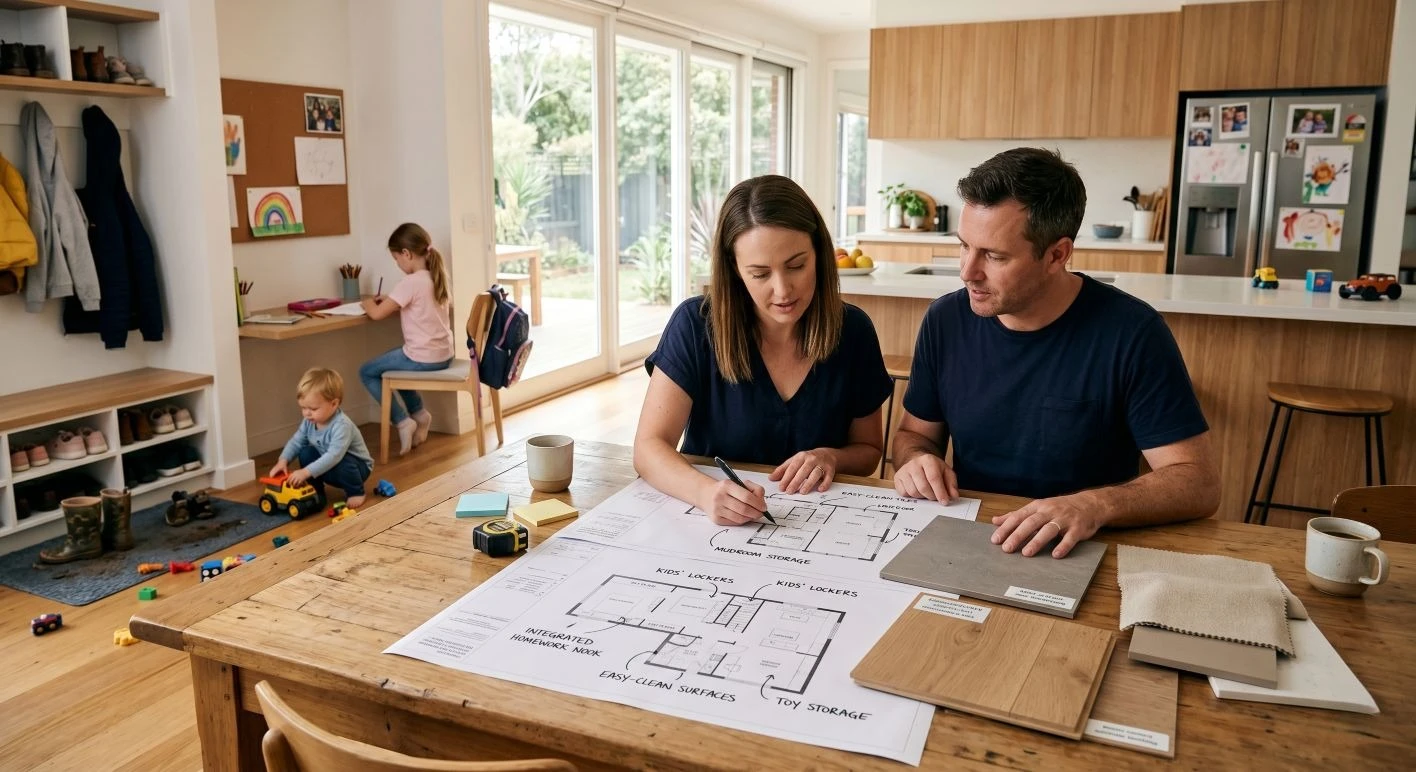
Open-plan looks great until three people are trying to do three noisy things at once.
When you’re rebuilding with children, function beats fashion every day of the week. I’d rather see a decent mud zone, proper storage, and a bedroom layout that supports sleep than another oversized island bench trying to become a personality trait.
Think about how your family actually moves through a day. Where do school bags land? Where do wet shoes go? Can one parent cook while a child does homework nearby without standing in the traffic path? Is there a toilet easy to access from outside? These details matter because they reduce friction. Friction is what wears families down.
The last time I walked through a freshly finished family home with clients, the smartest feature wasn’t the kitchen. It was a small study nook near the living area with a sliding door. Homework, bills, telehealth, quiet phone calls. Done. Simple. Useful. No applause needed.
Understand the local approvals and site risks early
Queensland sites can throw up surprises. Slope, stormwater, access, overlays, demolition constraints, soil issues. Ignore them early and you’ll pay for them later.
If you’re looking at a knockdown rebuild QLD project, get clear on council requirements, site conditions, service connections, and likely approval pathways before you get emotionally attached to a design. I’ve seen families lose months because they assumed their block was straightforward. It wasn’t. Few are.
This is where experienced local consultants earn their money. Not by talking fancy, but by spotting the annoying problems before they become expensive problems. You want straight answers about drainage, setbacks, buildability, and timing. If someone keeps everything vague, that’s your cue to get a second opinion.
Don’t confuse confidence with competence either. Plenty of people can sound certain. Much fewer can save you from a rotten site decision.
Build a communication system that survives stress
You do not need more group chats. You need one source of truth.
Pick a simple system for decisions, selections, invoices, contacts, and timeline updates. Shared folder. Spreadsheet. Project app. Doesn’t matter. What matters is that both adults can find the same information without asking, “Didn’t we already choose taps?”
Set rules. Big changes get discussed at night, not in the car. Budget decisions go in writing. Site issues get logged, not remembered badly. If one person speaks to the builder more often, they still need to report back clearly. Memory is hopeless under stress. Write things down.
Families who stay organised don’t always have easier builds. They just waste less energy repeating themselves.
Assume the kids will react, even if they seem fine
Some kids get clingy. Some get feral. Some go quiet and start chewing through their patience at school instead of at home.
That’s normal.
Tell them what’s happening in plain language. Show them timelines visually. Let them visit safe parts of the process if appropriate. Keep a few routines locked in no matter what, like Friday pizza, Saturday sport, bedtime stories, whatever your family already uses as an anchor. Stability doesn’t need to be fancy. It needs to be consistent.
And if your child struggles more than expected, don’t take it as proof the plan has failed. It just means they’re a kid, not a project manager. Fair enough, really.
Leave room for things to go wrong
Because they will.
A delay will happen. The cost will jump. Someone will get sick. A decision will need to be made faster than you’d like. That’s not negativity. That’s construction.
The best rebuild plans don’t pretend everything will run smoothly. They leave breathing room. Time buffer. Money buffer. Energy buffer. If you plan with zero slack, every hiccup becomes a crisis.
That’s the whole game, really. Not perfection. Capacity.
Get that right, and the new house has a much better chance of feeling like a win instead of a recovery story.
Share
Join our newsletter


